Freight Forwarding vs. Customs Clearance: What's the Difference and Why Both Matter
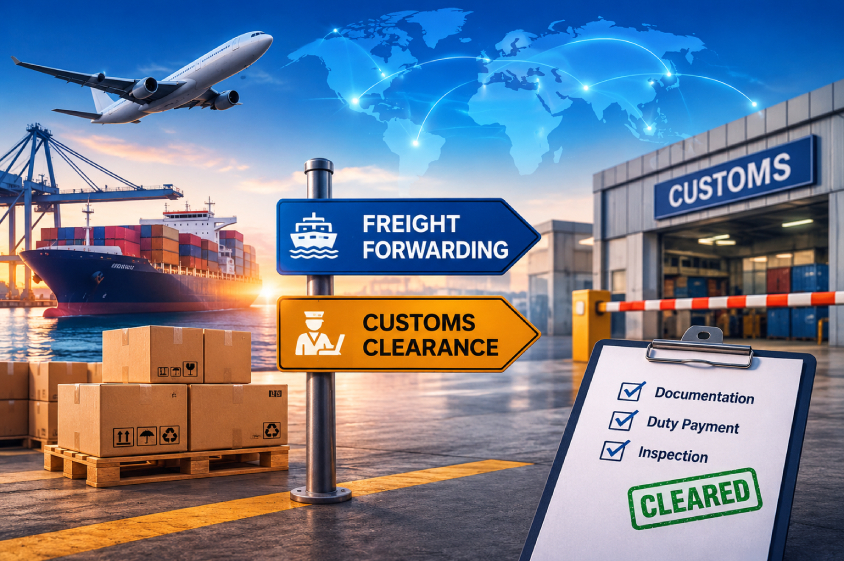
Freight forwarding and customs clearance are two different but connected parts of international trade. Freight forwarding is the process of planning, booking, and moving cargo from the exporter to the importer using ships, flights, trucks, or trains. Customs clearance is the legal process of getting that cargo approved by customs authorities through correct documentation, duty payment, and inspection. Freight forwarding gets the goods moving; customs clearance gets the goods legally allowed to cross the border. A shipment cannot reach its final destination smoothly unless both processes work together.
INTRODUCTION
Anyone new to import-export business often hears the terms "freight forwarding" and "customs clearance" used together, and sometimes even used interchangeably. In reality, they are two separate functions that happen to work side by side in every international shipment. Understanding the difference is not just useful trivia it directly affects how fast your cargo moves, how much it costs, and whether it gets stuck at a port or airport.
This guide breaks down what each process actually involves, how they differ, and why a business — or a career-focused professional needs to understand both to succeed in global trade.
WHAT IS FREIGHT FORWARDING?
Freight forwarding is the coordination and management of cargo movement from the point of origin to the point of destination. A freight forwarder acts like a travel agent for goods instead of people. They do not typically own the ships, planes, or trucks; instead, they arrange transport on behalf of the exporter or importer by working with shipping lines, airlines, and trucking companies.
Key responsibilities of a freight forwarder include:
- Choosing the best mode of transport (sea, air, road, or rail) based on cost, urgency, and cargo type
- Booking cargo space with shipping lines or airlines
- Consolidating smaller shipments (LCL) to reduce cost
- Preparing transport documents such as the Bill of Lading or Airway Bill
- Arranging warehousing, packing, and cargo insurance
- Tracking the shipment until it reaches the buyer
In short, freight forwarding is about logistics and physical movement getting the cargo from Point A to Point B in the most efficient way possible.
WHAT IS CUSTOMS CLEARANCE?
Customs clearance is the legal and regulatory process required before goods can enter or leave a country. Every shipment crossing an international border must be declared to customs authorities, verified against trade laws, and cleared for duty payment before it is released.
Key responsibilities in customs clearance include:
- Filing the shipping bill (for exports) or bill of entry (for imports)
- Classifying goods under the correct HS Code
- Calculating and paying applicable customs duty, GST, and cess
- Submitting supporting documents such as invoice, packing list, and certificate of origin
- Handling inspections or queries raised by customs officers
- Ensuring compliance with the Foreign Trade Policy and DGFT regulations
This work is usually carried out by a licensed Customs House Agent (CHA), also known as a Customs Broker, who is authorised to interact directly with customs authorities on behalf of the importer or exporter.
FREIGHT FORWARDING VS. CUSTOMS CLEARANCE: THE KEY DIFFERENCES
| Aspect | Freight Forwarding | Customs Clearance |
|---|---|---|
| Nature of work | Physical movement and logistics coordination | Legal documentation and regulatory compliance |
| Who handles it | Freight forwarder / logistics company | Licensed Customs House Agent (CHA) |
| Main goal | Move goods efficiently and cost-effectively | Get legal approval to cross the border |
| Key documents | Bill of Lading, Airway Bill | Shipping Bill, Bill of Entry, HS Code |
| Regulatory body | Shipping lines, airlines, ports | Indian Customs, DGFT, CBIC |
| When it happens | Throughout the transit journey | At the port/airport, before entry or exit |
WHY BOTH MATTER TOGETHER
A shipment cannot move smoothly on the strength of only one of these functions. Consider what happens if either link is weak:
- If freight forwarding is inefficient, cargo space is booked late, transit times increase, and costs go up due to poor route or carrier selection.
- If customs clearance is delayed or filed incorrectly, cargo gets held at the port, demurrage and detention charges pile up, and the buyer receives goods late even if the transport itself was flawless.
This is why most successful exporters, importers, and logistics companies either build in-house expertise in both areas or work with a partner who understands the full chain from booking the container to clearing it through customs. Businesses that understand both processes are better placed to negotiate with agents, avoid unnecessary charges, and keep their supply chain predictable.
CAREER RELEVANCE: WHY PROFESSIONALS SHOULD LEARN BOTH
For professionals building a career in export-import, logistics, or supply chain management, freight forwarding and customs clearance are not optional specialisations they are core skills. Recruiters in shipping lines, freight companies, and CHA firms consistently look for candidates who understand both documentation and logistics, because real-world shipments rarely stay confined to just one department.
This is exactly why NIFT (National Institute of Foreign Trade) designed its Certificate Course on Customs Clearance & Freight Forwarding to cover both sides of the process from booking cargo and understanding INCOTERMS 2020, to filing shipping bills, HS Code classification, and DGFT compliance. Learners who complete such training are better equipped to work as freight executives, documentation officers, or customs house agents from day one, rather than learning these processes on the job through trial and error.
NIFT also offers a dedicated Course for Custom House Agent (CHA – CBLR 2023 Exam) for those who want to specialise further in customs work, along with a Diploma in Export-Import Management and a Diploma in Supply Chain Management for a broader foundation in global trade.
CONCLUSION
Freight forwarding and customs clearance are two halves of the same journey one moves the cargo, the other makes sure it is legally allowed to move. Businesses that understand both can plan shipments more accurately, avoid costly delays, and build more reliable supply chains. For professionals, mastering both areas opens the door to a wide range of roles across shipping lines, freight companies, and customs brokerage firms.
If you want to build practical, job-ready expertise in this field, NIFT's Certificate Course on Customs Clearance & Freight Forwarding covers both sides of the process with real industry case studies and documentation practice. Explore the course details or get in touch with NIFT's admissions team to find a batch that fits your schedule.
Ready to master freight forwarding and customs clearance the practical way?
Enroll in NIFT's Certificate Course on Customs Clearance & Freight Forwarding and learn shipping bill filing, HS Code classification, INCOTERMS 2020, and end-to-end cargo documentation from industry experts.
Check the course batch dates and fees, or get in touch with NIFT's admissions team to speak with a course counsellor today.
FREQUENTLY ASKED QUESTIONS
Q1. Is a freight forwarder the same as a customs broker?
No. A freight forwarder arranges transport and logistics for cargo, while a customs broker (or Customs House Agent) handles the legal clearance of that cargo through customs. Some large logistics companies offer both services, but they are distinct roles requiring different licences and expertise.
Q2. Can a freight forwarder also do customs clearance?
Some freight forwarding companies employ licensed CHAs in-house or partner with one, allowing them to offer both services under one roof. However, only a licensed Customs House Agent is legally authorised to file customs documents and represent a shipment before customs authorities.
Q3. Why does my cargo get stuck even though the shipping line confirmed the booking?
A confirmed booking only covers transport. If the customs clearance documents such as the Bill of Entry or Shipping Bill are incomplete, incorrectly classified, or delayed, the cargo will be held at the port regardless of the transport arrangement.
Q4. Which skill should I learn first freight forwarding or customs clearance?
Most EXIM professionals benefit from learning both together, since real shipments require coordination between the two. A combined course, like NIFT's Certificate Course on Customs Clearance & Freight Forwarding, is the most practical starting point for beginners.
Q5. Does customs clearance apply to both imports and exports?
Yes. Every import requires a Bill of Entry and every export requires a Shipping Bill. The documentation, duty calculation, and compliance checks differ slightly between the two, but customs clearance is mandatory in both directions.